Good Morning.
The Epistle reading for Sunday, August 5, was taken from Colossians 3. We are invited to seek the things which are eternal .
One night a thief broke into the single-room apartment of French novelist, Honore de Balzac. Trying to avoid waking Balzac, the intruder quietly picked the lock on the writer’s desk. Suddenly, the silence was broken by a sarcastic laugh from the bed, where Balzac lay watching the thief. "Why do you laugh?" asked the thief. "I am laughing to think what risks you take to try to find money in a desk by night where the legal owner can never find any by day."
I think this story characterizes most people’s lives. They are trying to find money where there is no money. They are trying to find happiness where there is no happiness. They are trying to find comfort and security where there is none. They are trying to find something where there is nothing.
II Corinthians 4:18 states, “So we fix our eyes not on what is seen, but on what is unseen. For what is seen is temporary, but what is unseen is eternal.” What we see in this life is only temporary. It is not lasting. It is not eternal. It will never fully satisfy.
Every rusted wreck of a car in the junkyard was once new, shiny, sleek and desirable. All of those clothes we have thrown away or given away were once new, fashionable, and desirable, but not anymore.
We all need to look beyond this life and see the eternal. We need to see the big picture instead of our own little world. We need to see the eternal world more than this one. As Paul said in Colossians 3:2-3, “Set your minds on things above, not on earthly things. For you died, and your life is now hidden with Christ in God.”
Even though we have to live in this world we must see the next. We need to think more in the spiritual realm; we need to think about Christ, living for Christ both here and there.
Rick Warren hit the nail on the head in his book, "THE PURPOSE DRIVEN LIFE". Warren said, “It’s not about you. The purpose of your life is greater than your own personal fulfillment, your peace of mind, or even your happiness. It’s far greater than your family, your career, or even your wildest dreams and ambitions. If you want to know why you were placed on this planet, you must begin with God. You were born by His purpose and for His purpose.” To put it simply, life begins with God. Life also ends with God. Somehow we must sandwich Him in the middle of our lives.
Rick Warren further says that life is about worship, fellowship, discipleship, ministry, and mission.
WORSHIP - YOU WERE PLANNED FOR GOD’S PLEASURE- A congregation decided to have four worship services each Sunday. There was one for those new to the faith, for the FINDERS. Another for those who liked traditional worship, the KEEPERS. One for those who had lost their faith and would like to get it back, the LOSERS. The fourth was for those who had bad experiences with churches and were complaining about it, the WEEPERS. Hence, there were services for FINDERS, KEEPERS, LOSERS, WEEPERS. Regardless of who we are, whether we are finders, keepers, losers, or weepers, we all need to worship God. Regardless of where we are spiritually, we all need to worship God. This is God’s will or purpose for our lives.
In Hebrews 10:22-25 we read, “Let us draw near to God with a sincere heart in full assurance of faith, having our hearts sprinkled to cleanse us from a guilty conscience and having our bodies washed with pure water. Let us hold unswervingly to the hope we profess, for he who promised is faithful. And let us consider how we may spur one another on toward love and good deeds. Let us not give up meeting together, as some are in the habit of doing, but let us encourage one another -- and all the more as you see the Day approaching.”
Let us draw near to God. That is worship, and it pleases God when we worship Him. Why should we not worship Him? After all, He created us, He gives us life and breath and everything else, and He gives us the homes or houses we live in, the food we eat, the cars we drive, the clothes we wear, the luxuries we enjoy. IT IS ONLY RIGHT THAT WE WORSHIP HIM AS OUR CREATOR AND GIVING HEAVENLY FATHER! Worship is drawing near to God in faith and offering Him praise for who He is and what He has done.
Someone once said, “As a tear magnifies grief, as laughter magnifies humor, as a smile magnifies joy, so worship magnifies God.” Worship magnifies God in the sense that it enhances or multiplies our appreciation of Him. The more we focus on Him and praise Him, the more we think of Him and appreciate Him.
God desires that we should worship Him both publicly and privately. Every time you sit down to read your Bible, you are worshipping God. Every time you offer a prayer, you are worshipping. Every time you say, “Thank you, God” for something, you are worshipping. Every time you think or meditate about God and Christ or think about God’s Word, you are worshipping.
Let us not give up meeting together. That is public worship and we all need it. It is special, different, encouraging, stimulating, helpful, etc. There is something special about meeting together to worship God. We encourage one another in the faith. We are encouraged when we come together for a similar purpose.
At this time of the year we might be tempted to miss church for one reason or another. DON’T DO IT! If you’re in town, go to church. If you’re out of town, go to church. Engage in FELLOWSHIP - YOU WERE FORMED TO BE PART OF GOD’S FAMILY. Ephesians 3:14-15 “For this reason I kneel before the Father, from whom his whole family in heaven and on earth derives its name.”
DISCIPLESHIP - YOU WERE CREATED TO BECOME LIKE CHRIST - II Corinthians 2:14 states, “But thanks be to God, who always leads us in triumphal procession in Christ and through us spreads everywhere the fragrance of the knowledge of him.” II Corinthians 3:18, “And we, who with unveiled faces all reflect the Lord’s glory, are being transformed into his likeness with ever-increasing glory, which comes from the Lord, who is the Spirit.” A big part of discipleship is becoming like Christ. We all need the sweet fragrance of Christ in our lives. We all need to grow in His likeness.
Many Americans are interested in changing their appearance, according to an American Society for Aesthetic Plastic Surgery survey. Among all Americans, 39 percent of women and 22 percent of men wish that they could change something about their appearance. Most of us want to look good, to look our best, or at least to be somewhat presentable. I think most of us would like to change something about our appearance. However, the most important thing that we could change is our character. The physical is temporary but the spirit is eternal. Your body is temporary but the real you, your spirit, is eternal.
Henry Drummond wrote, “To become Christ-like is the only thing in the whole world worth caring for, the thing before which every ambition of man is folly and all lower achievement vain.” Our greatest goal in life is to become more like Christ. That’s God’s purpose for us.
MINISTRY - YOU WERE SHAPED FOR GOD’S SERVICE - Ephesians 4:11-12 states, “It was he who gave some to be apostles, some to be prophets, some to be evangelists, and some to be pastors and teachers, to prepare God’s people for works of service, so that the body of Christ may be built up.” God’s people are supposed to be involved in works of service or all kinds of Christian service.
Someone asked John Wanamaker in 1890: “How do you get time to run a Sunday school with your four thousand scholars, in addition to the business of your stores, your work as Postmaster-General, and other obligations?” Instantly Mr. Wanamaker replied: “Why, the Sunday school is my business! All other things are just things. Forty-five years ago I decided that God’s promise was sure: ‘Seek ye first the kingdom of God, and his righteousness; and all these things shall be added unto you.’ ” (Matthew 6:33) Wanamaker made God’s business his business, which is something we all need to do. God’s purpose is that we all get involved in some kind of meaningful Christian service!
MISSION - YOU WERE MADE TO TELL OTHERS ABOUT CHRIST - Matt. 28:18-19, “Then Jesus came to them and said, ‘All authority in heaven and on earth has been given to me. Therefore go and make disciples of all nations, baptizing them in the name of the Father and of the Son and of the Holy Spirit.’” God has given us a mission in life. It’s called the Great Commission by some. Acts 8:4 “Those who had been scattered preached the word wherever they went.” The early Christians preached the Word wherever they went. They had a mission to fulfill and a message to proclaim.
Max Lucado wrote these words in his new book, "IT’S NOT ABOUT ME". "Squint eyes. Firm jawed. Rawboned. Who? Pony Express riders. They had one assignment – deliver the message safely and quickly. They seized every advantage: the shortest route, the fastest horse, the lightest saddle. Only the sturdy were hired. The young and the orphans were preferred. Those selected were given $125 a month (a good salary in 1860), a Colt revolver, a lightweight rifle, a bright red shirt, blue trousers, and eight hours to cover eighty miles, six days a week. Hard work, but the message had to be delivered!"
The apostle Paul was much like the Pony Express rider. He was a hard worker, laboring for long hours, but the message had to be delivered!
Romans 1:14-16 says, “I am obligated both to Greeks and non-Greeks, both to the wise and the foolish. That is why I am so eager to preach the gospel also to you who are at Rome. I am not ashamed of the gospel, because it is the power of God for the salvation of everyone who believes: first for the Jew, then for the Gentile.”
Those who do know must tell those who do not know.
In Jesus our Lord,
Brown
Tuesday, August 7, 2007

Monday, August 6, 2007
Brown's Daily Word 8-6-07
Good Morning.
The Gospel reading for yesterday, Autust 5, was taken from Luke 12. I recently came across the following statements regarding the blessings we enjoy as we live in these United States.
If you have had an education and know how to read, then you are more blessed that over two billion people in the world that cannot read anything at all.
If you woke up this morning with more health than illness, you are more blessed than the million who won’t survive the week.
If you have food in your refrigerator, clothes on your back, a roof over your head and a place to sleep, you are richer than 75% of this world.
If you have money in the bank, in your wallet, and spare change lying in a dish, you are among the top 8% of the worlds wealthy.
And if you can attend a church meeting without fear of harassment, arrest, torture, or death, You are more blessed than almost three billion people in the world.
In Luke 12, we find Jesus sitting and teaching his disciples, but also sitting with them were many just listening to him teach. He was trying to teach his disciples to fear God alone, when he was suddenly interrupted by a man who was not trying to learn what Jesus was teaching, but he was adamant about his own problem. He blurts out and asks Jesus, “Teacher, tell my brother to divide the inheritance with me.”
Our Lord refused to be sidetracked from his mission of seeking and saving the lost. He looked at that man and saw that the problem wasn’t really the fair division of the inheritance, but one of ‘greed’. Jesus saw that not only did this man have a problem with greed, but also with the man’s brother. Jesus knew that no settlement would be satisfactory, until both the brothers had a change of heart.
“A change of heart”…that was what made Jesus’ teaching so different. He knew that everything that comes from Man starts in the heart. We find Jesus saying in Mark 7 verse 20,“What comes out of a man is what makes him unclean. For from within, out of men’s hearts come evil thoughts, sexual immorality, theft, murder, adultery, greed, malice, deceit, lewdness, envy, slander, arrogance and folly. All these evils come from inside and make a man unclean.”
What Jesus saw coming out of this man was ‘Greed”, and so he begins to teach about the sin of greed in the parable of the “Rich Man”. After all my reading, I don’t believe that Jesus had a problem with a man having possessions or even being wealthy. Jesus was concerned with the man’s Heart…where is your heart? Is your heart turned toward getting more and more of what you already have…or is your heart bent on loving and giving to where it is needed.
Proverbs 21:26 speaks to this very point, ”they are always greedy for more, while the godly love to give.”
Then, in verse fifteen, Jesus spoke, “And He said to them, 'Take heed and beware of covetous-ness, for one’s life does not consist in the abundance of the things he possesses.'" When he said, “take heed and beware”, he was literally saying, “be on guard against all kinds of greed.” The area of danger for this man was “greed or covetousness” (pleonexia) and it means “the lust to have more than one’s fair share, a grasping for more that is never satisfied” or to put it another way covetousness is “wanting more of what you already have enough of!”
Charles Swindoll has pictured it this way, “Picture a shipwrecked sailor on a life raft in the middle of the ocean. His terrible thirst impels him to drink the salt water, but it only make him thirstier. This causes him to drink even more, which makes him thirstier still. He consumes more and more of the salty water … until, paradoxically, he becomes dehydrated and dies.” [Charles Swindoll & Ken Gire. Study Guide. “Living Above the Level of Mediocrity.” (Anaheim, CA; Insight for Living, 1994). p. 83]
Beginning in Luke 12:16 is what is referred to as “The parable of the Rich Fool” in which the Lord shows us what happens when our hearts are focused exclusively on ourselves.
When Our Hearts Are Focused On Ourselves We Do Not Give God The Credit For Things He Has Done. (v. 16) “Then He spoke a parable to them, saying: "The ground of a certain rich man yielded plentifully.” This parable is addressed to the multitude, for it says that Jesus spoke this parable to them (plural). I think that it is important to note that this parable does not condemn this man for being rich. And to his credit it would appear that this man had come by his wealth honestly.
The rich man of this parable was farmer but he represents all human beings who are seduced by “all kinds of greed.” As this farmer looked at his amazing harvest he did not see the hand of God – he saw only his own effort. Yet he is a perfect example of greed because he has much and he expects to get more.
When Our Hearts Are Focused On Ourselves We Make Plans But Leave God Out. (vv. 17-18) "And he thought within himself, saying, ‘What shall I do, since I have no room to store my crops?’ (18) "So he said, ‘I will do this: I will pull down my barns and build greater, and there I will store all my crops and my goods.”
There was nothing intrinsically wrong with his desire to build more barns; it was both wise and prudent. The problem lay in the fact that there is no thought of sharing. In the original Greek the personal pronoun “my” occurs four times and “I” eight times. Even in the English we see the pronoun “I” five times and “my” four times. Notice he how he says my crops, my barns, my goods. He is confused between ownership and stewardship. It is not ours to own it is ours on loan.
When Our Hearts Are Focused On Ourselves We Consider Spending Our Resources Only On Ourselves. (v. 19) “ ‘And I will say to my soul, "Soul, you have many goods laid up for many years; take your ease; eat, drink, and be merry."‘
In this verse although he addresses himself as “soul” it is the physical life that he is really concerned about. This man thought that when he put his plan into being that he would he would have it made for years to come. But all of this is based on the fact that this man expected to control the fate of future crops. He envisioned the future as continually expanding and under his control. But nothing could be further from the truth.
The book of James speaks to just such an attitude (4:13-16) when he says, “Come now, you who say, "Today or tomorrow we will go to such and such a city, spend a year there, buy and sell, and make a profit"; (14) whereas you do not know what will happen tomorrow. For what is your life? It is even a vapor that appears for a little time and then vanishes away. (15) Instead you ought to say, "If the Lord wills, we shall live and do this or that."(16) But now you boast in your arrogance. All such boasting is evil.” The Bible does not discourage us from looking to the future with great expectation. However, as we make our plans, whether in business, in relationship or in our personal lives, we are to do so from the perspective that ultimately God is in charge. In other words, we need to plan with humility.
I wonder what this says about our American concept of retirement. I am not against retirement; I would like to be able to do so one day. But perhaps God would have us to look at it differently; perhaps to see it as a time when we have more free income and greater time on our hands than ever before to do some for the kingdom of God.
When Our Hearts Are Focused On Ourselves We Store Our Treasure In The Wrong Places. (v. 20) "But God said to him, ‘Fool! This night your soul will be required of you; then whose will those things be which you have provided?”
This man is pronounced a “fool” (aphron) by God. A fool in biblical language was not a description of mental ability but of spiritual discernment. According to Scripture a fool is a man who leaves God out of any consideration. Psalm 14:1 says, “The fool has said in his heart there is no God.” This man is a fool not because he has said this, but because he has lived his life as if God did not exist. He is a fool in that he did not recognize that his material blessings came from God, nor did he recognize any obligation to God in the use of his possessions. Fools leave God out of their lives. “Greed is “the logical result of the belief that there is no life after death. We grab what we can while we can however we can and then hold on to it hard.” [Sir Fred Catherwood. Evangelicals Now, September, 1994 http://www.bible.org/illus/g/g-83.htm]
“Leo Tolstoy once wrote a story about a successful peasant farmer who was not satisfied with his lot. He wanted more of everything. One day he received a novel offer. For 1000 rubles, he could buy all the land he could walk around in a day. The only catch in the deal was that he had to be back at his starting point by sundown.
Early the next morning he started out walking at a fast pace. By midday he was very tired, but he kept going, covering more and more ground. Well into the afternoon he realized that his greed had taken him far from the starting point. He quickened his pace and as the sun began to sink low in the sky, he began to run, knowing that if he did not make it back by sundown the opportunity to become an even bigger landholder would be lost.
As the sun began to sink below the horizon he came within sight of the finish line. Gasping for breath, his heart pounding, he called upon every bit of strength left in his body and staggered across the line just before the sun disappeared. He immediately collapsed, blood streaming from his mouth. In a few minutes he was dead. Afterwards, his servants dug a grave. It was not much over six feet long and three feet wide. The title of Tolstoy’s story was: How Much Land Does a Man Need? [Bits and Pieces, November, 1991 - http://www.bible.org/illus/g/g-83.htm]
To be a fool is to have missed the point of life. The remarkable thing is that this person that God calls a fool, we would very often call a success. Jesus says, “this very night your soul will be demanded of you.” The Greek verb translated required or demanded (apiteo) literally means “to demand back or require back” conveying the idea of life as a loan that must be repaid to God upon demand. He goes on in the second half of verse twenty to say, “Then whose will those things be which you have provided”. Long before the great philosopher Solomon made comment on this very problem in Ecclesiastes 2:21-23. “For though I do my work with wisdom, knowledge and skill, I must leave everything I gain to people who haven’t worked to earn it. This is not only foolish but highly unfair. (22) So what do people get for all their hard work? (23) Their days of labor are filled with pain and grief; even at night they cannot rest. It is all utterly meaningless.” (New Living Translation)
Since we cannot "take it with you", there is no need to wear ourselves out accumulating it. Everything you have will one day be left behind. It is yours now to use or to abuse, but one day it will be taken from you and you will stand before the Lord and give an account of how you used it. It would do well to remember the words of missionary Jim Elliot at this point, “He is no fool who gives what he cannot keep to gain that which he cannot lose.”
When Our Hearts Are Focused On Ourselves We Will Find Ourselves In Conflict With God’s Plan For Our Lives. (v. 21) "So is he who lays up treasure for himself, and is not rich toward God." Riches have one major weakness, they have no purchasing power after death. The “rich towards God” are those who use what God has given them for others. There are numerous examples in Scripture. People such as the centurion who build a synagogue for the people to worship in (Luke 7) and the home of Mary, Martha and Lazarus where Jesus often found rest (LUKE 10) were rich toward God. The way we become rich towards God is to invest in His church and in the lives of His people. However, don’t misunderstand me; it is not that the church needs your resources in order to survive, but that generosity will add an richness to your life that you would otherwise miss.
Please pray for Sunita, who is currently in Johannesburg, South Africa on assignment for World Vision. She is scheduled to return to Virginia on Saturday, August 11, and then the push is on toward the wedding.
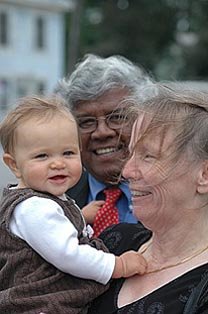
Pray for Alice, as she is driving to Boston today to spend some more time with Janice, Jeremy, Micah, and Simeon.
Pray for our friend, Dr. Allan Burns, who is having knee replacement surgery on Aug. 8.
Pray for the family of Edna Messersmith, a member of our church family here in Union Center, who died on Saturday morning. She was 11 days short of her 90th birthday. She was a wonderful servant of Jesus. She belonged to a group called the "crazy quilters", who made over 4,000 quilts for the homeless. Each quilt contained a Bible verse, and was wrapped in lots of love.
Pray for Millie Rood, as she goes for a biopsy and other tests in Pittsburgh this week.
We are planning and gearing up for "Operation No Sale" this Saturday under the tent (beside the Chicken BBQ). This event provides clothing and household essentials freely to members of the community who need them. It runs from 8 to 4 on Saturday and 11 to 4 on Sunday. The Chicken BBQ is from 12 to 4 on Saturday.
Happy 50th wedding anniversary blessings to our friends,Jack and Alice Black.
In Jesus our Lord,
Brown
The Gospel reading for yesterday, Autust 5, was taken from Luke 12. I recently came across the following statements regarding the blessings we enjoy as we live in these United States.
If you have had an education and know how to read, then you are more blessed that over two billion people in the world that cannot read anything at all.
If you woke up this morning with more health than illness, you are more blessed than the million who won’t survive the week.
If you have food in your refrigerator, clothes on your back, a roof over your head and a place to sleep, you are richer than 75% of this world.
If you have money in the bank, in your wallet, and spare change lying in a dish, you are among the top 8% of the worlds wealthy.
And if you can attend a church meeting without fear of harassment, arrest, torture, or death, You are more blessed than almost three billion people in the world.
In Luke 12, we find Jesus sitting and teaching his disciples, but also sitting with them were many just listening to him teach. He was trying to teach his disciples to fear God alone, when he was suddenly interrupted by a man who was not trying to learn what Jesus was teaching, but he was adamant about his own problem. He blurts out and asks Jesus, “Teacher, tell my brother to divide the inheritance with me.”
Our Lord refused to be sidetracked from his mission of seeking and saving the lost. He looked at that man and saw that the problem wasn’t really the fair division of the inheritance, but one of ‘greed’. Jesus saw that not only did this man have a problem with greed, but also with the man’s brother. Jesus knew that no settlement would be satisfactory, until both the brothers had a change of heart.
“A change of heart”…that was what made Jesus’ teaching so different. He knew that everything that comes from Man starts in the heart. We find Jesus saying in Mark 7 verse 20,“What comes out of a man is what makes him unclean. For from within, out of men’s hearts come evil thoughts, sexual immorality, theft, murder, adultery, greed, malice, deceit, lewdness, envy, slander, arrogance and folly. All these evils come from inside and make a man unclean.”
What Jesus saw coming out of this man was ‘Greed”, and so he begins to teach about the sin of greed in the parable of the “Rich Man”. After all my reading, I don’t believe that Jesus had a problem with a man having possessions or even being wealthy. Jesus was concerned with the man’s Heart…where is your heart? Is your heart turned toward getting more and more of what you already have…or is your heart bent on loving and giving to where it is needed.
Proverbs 21:26 speaks to this very point, ”they are always greedy for more, while the godly love to give.”
Then, in verse fifteen, Jesus spoke, “And He said to them, 'Take heed and beware of covetous-ness, for one’s life does not consist in the abundance of the things he possesses.'" When he said, “take heed and beware”, he was literally saying, “be on guard against all kinds of greed.” The area of danger for this man was “greed or covetousness” (pleonexia) and it means “the lust to have more than one’s fair share, a grasping for more that is never satisfied” or to put it another way covetousness is “wanting more of what you already have enough of!”
Charles Swindoll has pictured it this way, “Picture a shipwrecked sailor on a life raft in the middle of the ocean. His terrible thirst impels him to drink the salt water, but it only make him thirstier. This causes him to drink even more, which makes him thirstier still. He consumes more and more of the salty water … until, paradoxically, he becomes dehydrated and dies.” [Charles Swindoll & Ken Gire. Study Guide. “Living Above the Level of Mediocrity.” (Anaheim, CA; Insight for Living, 1994). p. 83]
Beginning in Luke 12:16 is what is referred to as “The parable of the Rich Fool” in which the Lord shows us what happens when our hearts are focused exclusively on ourselves.
When Our Hearts Are Focused On Ourselves We Do Not Give God The Credit For Things He Has Done. (v. 16) “Then He spoke a parable to them, saying: "The ground of a certain rich man yielded plentifully.” This parable is addressed to the multitude, for it says that Jesus spoke this parable to them (plural). I think that it is important to note that this parable does not condemn this man for being rich. And to his credit it would appear that this man had come by his wealth honestly.
The rich man of this parable was farmer but he represents all human beings who are seduced by “all kinds of greed.” As this farmer looked at his amazing harvest he did not see the hand of God – he saw only his own effort. Yet he is a perfect example of greed because he has much and he expects to get more.
When Our Hearts Are Focused On Ourselves We Make Plans But Leave God Out. (vv. 17-18) "And he thought within himself, saying, ‘What shall I do, since I have no room to store my crops?’ (18) "So he said, ‘I will do this: I will pull down my barns and build greater, and there I will store all my crops and my goods.”
There was nothing intrinsically wrong with his desire to build more barns; it was both wise and prudent. The problem lay in the fact that there is no thought of sharing. In the original Greek the personal pronoun “my” occurs four times and “I” eight times. Even in the English we see the pronoun “I” five times and “my” four times. Notice he how he says my crops, my barns, my goods. He is confused between ownership and stewardship. It is not ours to own it is ours on loan.
When Our Hearts Are Focused On Ourselves We Consider Spending Our Resources Only On Ourselves. (v. 19) “ ‘And I will say to my soul, "Soul, you have many goods laid up for many years; take your ease; eat, drink, and be merry."‘
In this verse although he addresses himself as “soul” it is the physical life that he is really concerned about. This man thought that when he put his plan into being that he would he would have it made for years to come. But all of this is based on the fact that this man expected to control the fate of future crops. He envisioned the future as continually expanding and under his control. But nothing could be further from the truth.
The book of James speaks to just such an attitude (4:13-16) when he says, “Come now, you who say, "Today or tomorrow we will go to such and such a city, spend a year there, buy and sell, and make a profit"; (14) whereas you do not know what will happen tomorrow. For what is your life? It is even a vapor that appears for a little time and then vanishes away. (15) Instead you ought to say, "If the Lord wills, we shall live and do this or that."(16) But now you boast in your arrogance. All such boasting is evil.” The Bible does not discourage us from looking to the future with great expectation. However, as we make our plans, whether in business, in relationship or in our personal lives, we are to do so from the perspective that ultimately God is in charge. In other words, we need to plan with humility.
I wonder what this says about our American concept of retirement. I am not against retirement; I would like to be able to do so one day. But perhaps God would have us to look at it differently; perhaps to see it as a time when we have more free income and greater time on our hands than ever before to do some for the kingdom of God.
When Our Hearts Are Focused On Ourselves We Store Our Treasure In The Wrong Places. (v. 20) "But God said to him, ‘Fool! This night your soul will be required of you; then whose will those things be which you have provided?”
This man is pronounced a “fool” (aphron) by God. A fool in biblical language was not a description of mental ability but of spiritual discernment. According to Scripture a fool is a man who leaves God out of any consideration. Psalm 14:1 says, “The fool has said in his heart there is no God.” This man is a fool not because he has said this, but because he has lived his life as if God did not exist. He is a fool in that he did not recognize that his material blessings came from God, nor did he recognize any obligation to God in the use of his possessions. Fools leave God out of their lives. “Greed is “the logical result of the belief that there is no life after death. We grab what we can while we can however we can and then hold on to it hard.” [Sir Fred Catherwood. Evangelicals Now, September, 1994 http://www.bible.org/illus/g/g-83.htm]
“Leo Tolstoy once wrote a story about a successful peasant farmer who was not satisfied with his lot. He wanted more of everything. One day he received a novel offer. For 1000 rubles, he could buy all the land he could walk around in a day. The only catch in the deal was that he had to be back at his starting point by sundown.
Early the next morning he started out walking at a fast pace. By midday he was very tired, but he kept going, covering more and more ground. Well into the afternoon he realized that his greed had taken him far from the starting point. He quickened his pace and as the sun began to sink low in the sky, he began to run, knowing that if he did not make it back by sundown the opportunity to become an even bigger landholder would be lost.
As the sun began to sink below the horizon he came within sight of the finish line. Gasping for breath, his heart pounding, he called upon every bit of strength left in his body and staggered across the line just before the sun disappeared. He immediately collapsed, blood streaming from his mouth. In a few minutes he was dead. Afterwards, his servants dug a grave. It was not much over six feet long and three feet wide. The title of Tolstoy’s story was: How Much Land Does a Man Need? [Bits and Pieces, November, 1991 - http://www.bible.org/illus/g/g-83.htm]
To be a fool is to have missed the point of life. The remarkable thing is that this person that God calls a fool, we would very often call a success. Jesus says, “this very night your soul will be demanded of you.” The Greek verb translated required or demanded (apiteo) literally means “to demand back or require back” conveying the idea of life as a loan that must be repaid to God upon demand. He goes on in the second half of verse twenty to say, “Then whose will those things be which you have provided”. Long before the great philosopher Solomon made comment on this very problem in Ecclesiastes 2:21-23. “For though I do my work with wisdom, knowledge and skill, I must leave everything I gain to people who haven’t worked to earn it. This is not only foolish but highly unfair. (22) So what do people get for all their hard work? (23) Their days of labor are filled with pain and grief; even at night they cannot rest. It is all utterly meaningless.” (New Living Translation)
Since we cannot "take it with you", there is no need to wear ourselves out accumulating it. Everything you have will one day be left behind. It is yours now to use or to abuse, but one day it will be taken from you and you will stand before the Lord and give an account of how you used it. It would do well to remember the words of missionary Jim Elliot at this point, “He is no fool who gives what he cannot keep to gain that which he cannot lose.”
When Our Hearts Are Focused On Ourselves We Will Find Ourselves In Conflict With God’s Plan For Our Lives. (v. 21) "So is he who lays up treasure for himself, and is not rich toward God." Riches have one major weakness, they have no purchasing power after death. The “rich towards God” are those who use what God has given them for others. There are numerous examples in Scripture. People such as the centurion who build a synagogue for the people to worship in (Luke 7) and the home of Mary, Martha and Lazarus where Jesus often found rest (LUKE 10) were rich toward God. The way we become rich towards God is to invest in His church and in the lives of His people. However, don’t misunderstand me; it is not that the church needs your resources in order to survive, but that generosity will add an richness to your life that you would otherwise miss.
Please pray for Sunita, who is currently in Johannesburg, South Africa on assignment for World Vision. She is scheduled to return to Virginia on Saturday, August 11, and then the push is on toward the wedding.
Pray for Alice, as she is driving to Boston today to spend some more time with Janice, Jeremy, Micah, and Simeon.
Pray for our friend, Dr. Allan Burns, who is having knee replacement surgery on Aug. 8.
Pray for the family of Edna Messersmith, a member of our church family here in Union Center, who died on Saturday morning. She was 11 days short of her 90th birthday. She was a wonderful servant of Jesus. She belonged to a group called the "crazy quilters", who made over 4,000 quilts for the homeless. Each quilt contained a Bible verse, and was wrapped in lots of love.
Pray for Millie Rood, as she goes for a biopsy and other tests in Pittsburgh this week.
We are planning and gearing up for "Operation No Sale" this Saturday under the tent (beside the Chicken BBQ). This event provides clothing and household essentials freely to members of the community who need them. It runs from 8 to 4 on Saturday and 11 to 4 on Sunday. The Chicken BBQ is from 12 to 4 on Saturday.
Happy 50th wedding anniversary blessings to our friends,Jack and Alice Black.
In Jesus our Lord,
Brown
Tuesday, July 31, 2007
Brown's Daily Word 7-30-07
Good Morning.
Praise the Lord for the world in which we live. Praise the Lord for His Word which endures forever. One of the readings for yesterday was taken from Luke 12. This is the record of our Lord's teaching on prayer. Jesus had taught the woman of Samaria on how to worship. Now He teaches His disciples on prayer. Our Lord God is living and He is at work 24/7. He neither sleeps nor slumbers. His telephone # is Jeremiah 33.3. He answers prayer in His divine will and providence.
A tavern was being built in a town that had previously been dry. In opposition to the tavern, a group of Christians began an all night prayer meeting and asked God to intervene. Lightning then struck the tavern and burned it down. The owner of the tavern brought a lawsuit against the church and held them responsible. The Christians hired a lawyer and denied responsibility. In response to this unusual scenario, the judge said, "No matter how this case comes out, one thing is clear. The tavern owner believes in prayer, and the Christians do not."
Jesus gave the Lord’s Prayer in response to the disciple’s request in (v. 1), “Lord, teach us to pray?” The disciples seem to have waited a long time to ask Jesus to teach them to pray. We begin our examination of the Lord’s Prayer by looking at the first four English words, “Our Father in Heaven.” Here Jesus is stating the importance of starting our prayers with the awareness that God is our Father. What Jesus is teaching is pretty revolutionary. The word that Jesus used for Father was not a formal word. It was the common Aramaic word with which a child would address his father – the word “Abba”. Of course, everyone used this word, but no one under any circumstances had ever used it in connection with God. “Abba” meant something like “Daddy”, but with a more reverent touch than how we use the word today. It may have meant something more like, “Dearest Father.”
When Jesus came on the scene he addressed God only as “Father.” All of his prayers addressed God as “Father.” The Gospels record his use of “Father” more than sixty times in reference to God; perhaps you have a great hindrance in this area because did not have a good role model in your earthly father! Perhaps your father was angry and unapproachable or abusive. In such a case, one way to overcome this is to think of God as being everything you ever wished for in a father. God can become for you the fulfillment of your dream for a honorable and decent father who loves you unconditionally. The beginning of effective prayer is the recognition that God possesses a true father’s heart, a father’s love, a father’s strength, and a father’s concern for the best interest of his children.
This concept of a loving heavenly father provides us with a profound sense of being loved. It certainly needs to be remembered that it is impossible to come to God as our Father except that we are born into his family through faith in Jesus Christ. This prayer is based on a relationship with God through faith in Christ and can only be uttered by those who are in the family. When we begin our prayer, “Our Father,” we begin to pray based on an intimate relationship with God – that of a father and child. God is not an angry judge looking for an opportunity to condemn us, nor is aloof and distant, too busy to hear you. He is our Father and can be approached on an intimate basis.
Having the foundational awareness of God as our Father we move on to the first of the petitions, “hallowed be your name.” The Lord’s Prayer contains seven petitions; the first three petitions are called the “Thy Petitions” because in the King James Version they begin with the word “thy” and they center on God.
Thy name be hallowed
Thy kingdom come
Thy will be done
When you pray “hallowed be your name,” you climb to a new level of respect for God and reverence for his person. You are ascending to the very heart of God to recognize who He is and what He has done for us.
When Jesus taught us to pray “hallowed be your name,” He was telling us to make the presence of God real in our hearts. When you pray “hallowed be thy name,” you are placing God on the throne of your heart. It is about putting God on the throne of our lives on earth, as He sits upon His throne in heaven. How do we “hallow” his name? We hallow, or make holy, his name with our lips, both privately and publicly, and by our actions. To pray that His name is “hallowed” means that first and foremost we desire our lives to reveal to others to the name of Jesus and the character or God.
When we pray “your Kingdom come” this prayer recognizes God’s kingdom, and His rule, His dominion, and His authority over us. If we truly desire God’s rule over all men and women at a future time, then it follows that we desire that He will work out His will in our lives now. When we pray, “your kingdom come,” we are acknowledging God’s right to rule all people, including us. It is unfortunately true that untold millions of individuals have repeated the words “your will be done” down through the centuries without the faintest notion of what God’s will is. Perhaps even more alarming is that even more people have repeated these words without any intention whatever of seeing to it that the Father’s will is done.
When you ask “your will be done,” you must be willing to do it “right now.” Notice that you are not asking God to change His will or to bless your will; you are asking Him to help you find and do His will in your life.
But it is not enough just to know the will God; one must then apply it. “Your will be done”, is in reality a prayer of submission. According to Romans 12:2, it is our privilege to submit to “… that good and acceptable and perfect will of God.” (NKJV). The truth is that the cause of all the unrest, frustration, unhappiness and sense of powerlessness in the life of a Christian can be traced to trying to follow our own self-will. At the back of all our failure is the desire to have our own way, not His way; it’s basis is a will that says No to God!
As have seen the first three petitions have to do with God. The second set of four petitions, which we begin to examine now, have to do with human well-being and are distinguished by the word “us:” “give us,” “forgive us,” “keep us” and “lead us.” In last half of the prayer we turn from praying for God’s glory to praying for our needs. One of the profound realities of the Christian life is the realization that God cares about the simple, day-to-day, needs of our lives. He cares whether we are warm, fed and housed. He is concerned for our whole well-being, including those things necessary to sustain life.
"Give us this day our daily bread." What does this request mean? We miss its importance for the simple fact that when you awoke this morning, none of you had even the slightest doubt that you would be able to eat today. Most of the major concerns for the average American are in what will we eat, not whether we will eat. We are told to pray “give us day by day our daily bread,” to remind us of our absolute dependence on God for everything. God made us with needs so that we would have to look to Him to supply them. In this prayer for “daily bread,” bread stands for more than just food. It stands for all the physical things we need for life. To pray this prayer for “our daily bread,” expresses our conviction and belief that God is able to answer our prayer and to meet our needs. It is not that we are praying to overcome God’s unwillingness or overcome his reluctance, seeking to bend His will to ours, but it is rather the taking hold of God’s willingness to give.
In the spiritual realm it is just as true that yesterday’s strength is absolutely useless to fight today’s battles. Sometimes we, as Christians, rely on our experiences with God in the past. Of course they were good, but we need a fresh touch of God in our lives every day. God never gives us a reservoir of grace in our lives, but expects to turn to Him everyday for the grace sufficient to meet the challenges of that day.
The phrase, “this day” reminds us as believers that we need daily renewal of our spiritual strength. We often get stressed out with anxiety because we try to face the problems of tomorrow today. Jesus addressed the problem of worry in the Sermon on the Mount were he said, “Therefore do not worry, saying, ‘What shall we eat?’ or ‘What shall we drink?’ or ‘What shall we wear?’ (32) For after all these things the Gentiles seek. For your heavenly Father knows that you need all these things. (33) But seek first the kingdom of God and His righteousness, and all these things shall be added to you. (34) Therefore do not worry about tomorrow, for tomorrow will worry about its own things. Sufficient for the day is its own trouble.” (Matt 6:31-34 NKJV). When we worry about tomorrow we are telling the heavenly father that we are not sure that He can provide for tomorrow’s bread. The invitation to pray “give us day-by-day our daily bread,” is an invitation to come to God with even those things that others might call small. We are not just to bring the big things to God but even our ordinary request – for a coat, for shoes, a vacation, groceries, or even a bicycle.
The ultimate bread is Jesus Christ himself. The only bread that will satisfy completely and forever is the provision of the Lord Jesus Himself. “I am the living bread which came down from heaven. If anyone eats of this bread, he will live forever; and the bread that I shall give is My flesh, which I shall give for the life of the world.” John 6:51 (NKJV)
6. Praying On the Basis of God’s Pardon - “Forgive Us Our Sins”
This petition is not only an explicit prayer for forgiveness, “forgive us our sins,” but also for a forgiving spirit, “for we also forgive everyone who is indebted to us.” In our model prayer after we have asked the Father for provision, now we ask for pardon. “Forgive” follows “give.” Look back at the beginning of verse four, note the word “and,” because it links the request for daily bread, with the request for daily forgiveness. In that way when we think of our need for food we will think of our need for forgiveness. Many of us are conscious of our need for daily bread, but are utterly unconscious of our need for daily forgiveness. If we are sincere when we pray, “forgive us our sins,” then we are openly admitting ourselves as guilty of wrongdoing, of sin. Many falsely presume that because when we are saved we have no further need to ask for forgiveness or confession of sin. This, of course, is not the case. 1 John 1:8-9 tell us, “If we say that we have no sin, we deceive ourselves, and the truth is not in us. (9) If we confess our sins, He is faithful and just to forgive us our sins and to cleanse us from all unrighteousness.” (NKJV) Christian’s still can and do sin and thus stand in need of daily confession and forgiveness.
It needs to be remembered that this is a “family prayer”; it does not deal with the sins of unbelievers. It does not deal with our standing before God, which was established at salvation, and which can never be affected; it concerns the sins of the children of God, which hamper our fellowship with the Father. No non-Christian ever receives forgiveness from God on the basic of claiming to forgive someone else. Although we receive forgiveness when we were saved we will never be able to enjoy full cleansing in our Christian walk unless we are ready to extend it freely to those who offend us. True believers are forgiven and forgiving. That does not mean that forgiveness ever comes easily or naturally even to real Christians. It is always a battle to maintain a forgiving spirit. But the struggle to forgive is in itself evidence of God’s grace in a person’s heart, because otherwise he or she would just give in to bitterness. The warning here is for those who claim to be Christians and but who will not forgive and have no desire to do so.
Some say "I can’t forgive", but is it really "I can’t" or "I won’t"? Jesus did not tell the disciples that they could pray, “Lord, forgive me my trespasses and I will try to forgive those who have wronged me.” He told them that when they had forgiven others they could then claim their own forgiveness.
Ray Stedman tells the story of one man’s explanation for his lack of forgiveness. He said, “A man once said to me, ‘I know I’m a Christian, but someone once did an awful thing to me – something I just can’t forget or forgive.’ I replied, ‘Are you sure you can’t forgive him?’ He maintained that he had really tried to forgive this man, but was unable to do so. As we continued talking, I said, ‘I know, I have found that we often use the word can’t what we really mean is won’t. Isn’t possible that what you are saying is not, “I can’t forgive him,’ but ‘I won’t forgive him?’ If it is really true that you cannot forgive this man, then it indicates that you yourself have never been forgiven and you are only kidding yourself about being a Christian.’ This shook him a bit. He thought it through and then, with a rather sheepish grin, he said, ‘I guess you’re right. I guess I won’t.’ It wasn’t long before he came to me and reported with joy that he had finally forgiven the man who had injured him.” [Ray Stedman. Talking With My Father. ( Grand Rapids; Discovery House, 1997) p. 73
It is possible that right here we are touching upon one of the principle causes of unanswered prayer. Is it possible that anyone would truly rather have his own prayers unanswered for the human satisfaction of hating someone and holding on to a grudge against someone who has offended us? When we do not forgive we set up a roadblock in our prayer life.
7. Praying On the Basis of God’s Protection - “And do not Lead Us Into Temptation” In the preceding petition “forgive us our sins,” the request was that sins already committed might be forgiven, but here we have a plea to be delivered from falling into new sins. The petition in the prayer is primarily for protection. By teaching us to pray for God to “not lead us into temptation”, he is not suggesting that God is the one who tempts us. James states that God “does not tempt anyone” (James 1:13). Rather, it accepts the danger of temptation, acknowledges our deficiency in dealing with it, and asks for deliverance from it. If we are to win in the battle against temptation we must realize the reality of Spiritual warfare. We cannot be victorious over that which we do not understand. Being ignorant of the fact that there is a great spiritual battle being fought in our world does not erase that fact that it is.
We also need to acknowledge our inability to handle temptation on our own. We need to remember everyone is vulnerable to temptation and no one is above falling. No matter how old we are or how mature in the faith we are, although the strength of certain temptations may diminish somewhat with age, we are never free from temptation as long as we live in this world. When we pray for God’s protection from temptation we are agreeing with the High priestly prayer of Jesus. He prayed, “I do not pray that You should take them out of the world, but that You should keep them from the evil one.” John 17:15 (NKJV)
The second part of the prayer for God’s protection is found in the request, “Deliver Us From Evil One.” The King James Version translates this, “deliver us from evil” but The New King James Version, The New International Version and The New English Bible translations render it, “deliver us from the evil one” – referring of course to Satan. When you use the phrase “deliver us from the evil one” you are admitting that this life is a struggle with an enemy that opposes us. Because we do not know what dangers we will face each new day, we need God’s protection to cover us. When we pray “deliver us from the evil one” we are turning your protection over to God.
Although Satan may be the ruler of this present evil world, though he may be the prince of the power of the air, though he may have cohorts of evil spirits at his command, he has no claim over the children of God. Greater is He who is in us than he who is in the world.
In Jesus,
Brown
Praise the Lord for the world in which we live. Praise the Lord for His Word which endures forever. One of the readings for yesterday was taken from Luke 12. This is the record of our Lord's teaching on prayer. Jesus had taught the woman of Samaria on how to worship. Now He teaches His disciples on prayer. Our Lord God is living and He is at work 24/7. He neither sleeps nor slumbers. His telephone # is Jeremiah 33.3. He answers prayer in His divine will and providence.
A tavern was being built in a town that had previously been dry. In opposition to the tavern, a group of Christians began an all night prayer meeting and asked God to intervene. Lightning then struck the tavern and burned it down. The owner of the tavern brought a lawsuit against the church and held them responsible. The Christians hired a lawyer and denied responsibility. In response to this unusual scenario, the judge said, "No matter how this case comes out, one thing is clear. The tavern owner believes in prayer, and the Christians do not."
Jesus gave the Lord’s Prayer in response to the disciple’s request in (v. 1), “Lord, teach us to pray?” The disciples seem to have waited a long time to ask Jesus to teach them to pray. We begin our examination of the Lord’s Prayer by looking at the first four English words, “Our Father in Heaven.” Here Jesus is stating the importance of starting our prayers with the awareness that God is our Father. What Jesus is teaching is pretty revolutionary. The word that Jesus used for Father was not a formal word. It was the common Aramaic word with which a child would address his father – the word “Abba”. Of course, everyone used this word, but no one under any circumstances had ever used it in connection with God. “Abba” meant something like “Daddy”, but with a more reverent touch than how we use the word today. It may have meant something more like, “Dearest Father.”
When Jesus came on the scene he addressed God only as “Father.” All of his prayers addressed God as “Father.” The Gospels record his use of “Father” more than sixty times in reference to God; perhaps you have a great hindrance in this area because did not have a good role model in your earthly father! Perhaps your father was angry and unapproachable or abusive. In such a case, one way to overcome this is to think of God as being everything you ever wished for in a father. God can become for you the fulfillment of your dream for a honorable and decent father who loves you unconditionally. The beginning of effective prayer is the recognition that God possesses a true father’s heart, a father’s love, a father’s strength, and a father’s concern for the best interest of his children.
This concept of a loving heavenly father provides us with a profound sense of being loved. It certainly needs to be remembered that it is impossible to come to God as our Father except that we are born into his family through faith in Jesus Christ. This prayer is based on a relationship with God through faith in Christ and can only be uttered by those who are in the family. When we begin our prayer, “Our Father,” we begin to pray based on an intimate relationship with God – that of a father and child. God is not an angry judge looking for an opportunity to condemn us, nor is aloof and distant, too busy to hear you. He is our Father and can be approached on an intimate basis.
Having the foundational awareness of God as our Father we move on to the first of the petitions, “hallowed be your name.” The Lord’s Prayer contains seven petitions; the first three petitions are called the “Thy Petitions” because in the King James Version they begin with the word “thy” and they center on God.
Thy name be hallowed
Thy kingdom come
Thy will be done
When you pray “hallowed be your name,” you climb to a new level of respect for God and reverence for his person. You are ascending to the very heart of God to recognize who He is and what He has done for us.
When Jesus taught us to pray “hallowed be your name,” He was telling us to make the presence of God real in our hearts. When you pray “hallowed be thy name,” you are placing God on the throne of your heart. It is about putting God on the throne of our lives on earth, as He sits upon His throne in heaven. How do we “hallow” his name? We hallow, or make holy, his name with our lips, both privately and publicly, and by our actions. To pray that His name is “hallowed” means that first and foremost we desire our lives to reveal to others to the name of Jesus and the character or God.
When we pray “your Kingdom come” this prayer recognizes God’s kingdom, and His rule, His dominion, and His authority over us. If we truly desire God’s rule over all men and women at a future time, then it follows that we desire that He will work out His will in our lives now. When we pray, “your kingdom come,” we are acknowledging God’s right to rule all people, including us. It is unfortunately true that untold millions of individuals have repeated the words “your will be done” down through the centuries without the faintest notion of what God’s will is. Perhaps even more alarming is that even more people have repeated these words without any intention whatever of seeing to it that the Father’s will is done.
When you ask “your will be done,” you must be willing to do it “right now.” Notice that you are not asking God to change His will or to bless your will; you are asking Him to help you find and do His will in your life.
But it is not enough just to know the will God; one must then apply it. “Your will be done”, is in reality a prayer of submission. According to Romans 12:2, it is our privilege to submit to “… that good and acceptable and perfect will of God.” (NKJV). The truth is that the cause of all the unrest, frustration, unhappiness and sense of powerlessness in the life of a Christian can be traced to trying to follow our own self-will. At the back of all our failure is the desire to have our own way, not His way; it’s basis is a will that says No to God!
As have seen the first three petitions have to do with God. The second set of four petitions, which we begin to examine now, have to do with human well-being and are distinguished by the word “us:” “give us,” “forgive us,” “keep us” and “lead us.” In last half of the prayer we turn from praying for God’s glory to praying for our needs. One of the profound realities of the Christian life is the realization that God cares about the simple, day-to-day, needs of our lives. He cares whether we are warm, fed and housed. He is concerned for our whole well-being, including those things necessary to sustain life.
"Give us this day our daily bread." What does this request mean? We miss its importance for the simple fact that when you awoke this morning, none of you had even the slightest doubt that you would be able to eat today. Most of the major concerns for the average American are in what will we eat, not whether we will eat. We are told to pray “give us day by day our daily bread,” to remind us of our absolute dependence on God for everything. God made us with needs so that we would have to look to Him to supply them. In this prayer for “daily bread,” bread stands for more than just food. It stands for all the physical things we need for life. To pray this prayer for “our daily bread,” expresses our conviction and belief that God is able to answer our prayer and to meet our needs. It is not that we are praying to overcome God’s unwillingness or overcome his reluctance, seeking to bend His will to ours, but it is rather the taking hold of God’s willingness to give.
In the spiritual realm it is just as true that yesterday’s strength is absolutely useless to fight today’s battles. Sometimes we, as Christians, rely on our experiences with God in the past. Of course they were good, but we need a fresh touch of God in our lives every day. God never gives us a reservoir of grace in our lives, but expects to turn to Him everyday for the grace sufficient to meet the challenges of that day.
The phrase, “this day” reminds us as believers that we need daily renewal of our spiritual strength. We often get stressed out with anxiety because we try to face the problems of tomorrow today. Jesus addressed the problem of worry in the Sermon on the Mount were he said, “Therefore do not worry, saying, ‘What shall we eat?’ or ‘What shall we drink?’ or ‘What shall we wear?’ (32) For after all these things the Gentiles seek. For your heavenly Father knows that you need all these things. (33) But seek first the kingdom of God and His righteousness, and all these things shall be added to you. (34) Therefore do not worry about tomorrow, for tomorrow will worry about its own things. Sufficient for the day is its own trouble.” (Matt 6:31-34 NKJV). When we worry about tomorrow we are telling the heavenly father that we are not sure that He can provide for tomorrow’s bread. The invitation to pray “give us day-by-day our daily bread,” is an invitation to come to God with even those things that others might call small. We are not just to bring the big things to God but even our ordinary request – for a coat, for shoes, a vacation, groceries, or even a bicycle.
The ultimate bread is Jesus Christ himself. The only bread that will satisfy completely and forever is the provision of the Lord Jesus Himself. “I am the living bread which came down from heaven. If anyone eats of this bread, he will live forever; and the bread that I shall give is My flesh, which I shall give for the life of the world.” John 6:51 (NKJV)
6. Praying On the Basis of God’s Pardon - “Forgive Us Our Sins”
This petition is not only an explicit prayer for forgiveness, “forgive us our sins,” but also for a forgiving spirit, “for we also forgive everyone who is indebted to us.” In our model prayer after we have asked the Father for provision, now we ask for pardon. “Forgive” follows “give.” Look back at the beginning of verse four, note the word “and,” because it links the request for daily bread, with the request for daily forgiveness. In that way when we think of our need for food we will think of our need for forgiveness. Many of us are conscious of our need for daily bread, but are utterly unconscious of our need for daily forgiveness. If we are sincere when we pray, “forgive us our sins,” then we are openly admitting ourselves as guilty of wrongdoing, of sin. Many falsely presume that because when we are saved we have no further need to ask for forgiveness or confession of sin. This, of course, is not the case. 1 John 1:8-9 tell us, “If we say that we have no sin, we deceive ourselves, and the truth is not in us. (9) If we confess our sins, He is faithful and just to forgive us our sins and to cleanse us from all unrighteousness.” (NKJV) Christian’s still can and do sin and thus stand in need of daily confession and forgiveness.
It needs to be remembered that this is a “family prayer”; it does not deal with the sins of unbelievers. It does not deal with our standing before God, which was established at salvation, and which can never be affected; it concerns the sins of the children of God, which hamper our fellowship with the Father. No non-Christian ever receives forgiveness from God on the basic of claiming to forgive someone else. Although we receive forgiveness when we were saved we will never be able to enjoy full cleansing in our Christian walk unless we are ready to extend it freely to those who offend us. True believers are forgiven and forgiving. That does not mean that forgiveness ever comes easily or naturally even to real Christians. It is always a battle to maintain a forgiving spirit. But the struggle to forgive is in itself evidence of God’s grace in a person’s heart, because otherwise he or she would just give in to bitterness. The warning here is for those who claim to be Christians and but who will not forgive and have no desire to do so.
Some say "I can’t forgive", but is it really "I can’t" or "I won’t"? Jesus did not tell the disciples that they could pray, “Lord, forgive me my trespasses and I will try to forgive those who have wronged me.” He told them that when they had forgiven others they could then claim their own forgiveness.
Ray Stedman tells the story of one man’s explanation for his lack of forgiveness. He said, “A man once said to me, ‘I know I’m a Christian, but someone once did an awful thing to me – something I just can’t forget or forgive.’ I replied, ‘Are you sure you can’t forgive him?’ He maintained that he had really tried to forgive this man, but was unable to do so. As we continued talking, I said, ‘I know, I have found that we often use the word can’t what we really mean is won’t. Isn’t possible that what you are saying is not, “I can’t forgive him,’ but ‘I won’t forgive him?’ If it is really true that you cannot forgive this man, then it indicates that you yourself have never been forgiven and you are only kidding yourself about being a Christian.’ This shook him a bit. He thought it through and then, with a rather sheepish grin, he said, ‘I guess you’re right. I guess I won’t.’ It wasn’t long before he came to me and reported with joy that he had finally forgiven the man who had injured him.” [Ray Stedman. Talking With My Father. ( Grand Rapids; Discovery House, 1997) p. 73
It is possible that right here we are touching upon one of the principle causes of unanswered prayer. Is it possible that anyone would truly rather have his own prayers unanswered for the human satisfaction of hating someone and holding on to a grudge against someone who has offended us? When we do not forgive we set up a roadblock in our prayer life.
7. Praying On the Basis of God’s Protection - “And do not Lead Us Into Temptation” In the preceding petition “forgive us our sins,” the request was that sins already committed might be forgiven, but here we have a plea to be delivered from falling into new sins. The petition in the prayer is primarily for protection. By teaching us to pray for God to “not lead us into temptation”, he is not suggesting that God is the one who tempts us. James states that God “does not tempt anyone” (James 1:13). Rather, it accepts the danger of temptation, acknowledges our deficiency in dealing with it, and asks for deliverance from it. If we are to win in the battle against temptation we must realize the reality of Spiritual warfare. We cannot be victorious over that which we do not understand. Being ignorant of the fact that there is a great spiritual battle being fought in our world does not erase that fact that it is.
We also need to acknowledge our inability to handle temptation on our own. We need to remember everyone is vulnerable to temptation and no one is above falling. No matter how old we are or how mature in the faith we are, although the strength of certain temptations may diminish somewhat with age, we are never free from temptation as long as we live in this world. When we pray for God’s protection from temptation we are agreeing with the High priestly prayer of Jesus. He prayed, “I do not pray that You should take them out of the world, but that You should keep them from the evil one.” John 17:15 (NKJV)
The second part of the prayer for God’s protection is found in the request, “Deliver Us From Evil One.” The King James Version translates this, “deliver us from evil” but The New King James Version, The New International Version and The New English Bible translations render it, “deliver us from the evil one” – referring of course to Satan. When you use the phrase “deliver us from the evil one” you are admitting that this life is a struggle with an enemy that opposes us. Because we do not know what dangers we will face each new day, we need God’s protection to cover us. When we pray “deliver us from the evil one” we are turning your protection over to God.
Although Satan may be the ruler of this present evil world, though he may be the prince of the power of the air, though he may have cohorts of evil spirits at his command, he has no claim over the children of God. Greater is He who is in us than he who is in the world.
In Jesus,
Brown
Subscribe to:
Posts (Atom)