Praise the Lord!
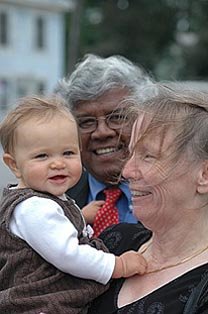
The Lord gave us a glorious and gracious long weekend. The weather was warm and brilliant. Janice, Jeremy, Micah, Simeon, Laureen, and Alice had a wonderful weekend in beautiful Burlington, Vermont. Our friends Linda and Warren went all out to spoil them. Now they are all back in their respective dwelling places, having arrived safely last evening. We heard from Sunita, who is currently in Uganda, where she arrived safely. Sunita tells me Uganda is a beautiful country. It is called the pearl of Africa. It is the size of England, and has a population of 42 million people. The dominant religion is the Christian Faith. The river Nile originates in Uganda and flows North. It is the mega-mango season in Uganda.
Jessica and Tom came home for the weekend. We had a very blessed time together. I had a weekend full with visitations, wedding, worship services, and a funeral. Because of Jesus we can do life and death well. The man who died had been blessed with two children, 4 grandchildren and two great-grandchildren. His son, daughter, and their families love Jesus, and are involved in serving Christ. Both son and daughter spoke about how their dad loved them, how he loved Jesus, and that they have the blessed assurance of seeing him in the presence of Jesus some day.
We were blessed with a marvelous Memorial Day yesterday. My brother Caleb and his wife Sandhya cooked lots of Indian foods, including all kinds of desserts. We praise Jesus for His generosity and grace.
The Psalm for Sunday was taken from Psalm 62. It is a psalm of King David, which he wrote while he was in the wilderness. There were two times when David was out in the wilderness of the Judean desert. The first time was when King Saul was hunting him down in the later chapters of 1 Samuel. The second time David was on the run was when his son Absalom had conspired against his own father and declared himself king, according to 2 Samuel. We know from Psalm 63:11 that David was the king when he wrote this psalm (Psalm 62), so the setting must have been when he was fleeing from Absalom, since he wasn’t king when Saul was chasing him. After David had sinned with Bathsheba and sent her husband, Uriah, to be killed in battle, Nathan the prophet rebuked him by saying, “You are the man”. In 2 Samuel 12:7, David was told that things were going to fracture in his own family in verse 11: “This is what the Lord says: ‘Out of your own household I am going to bring calamity upon you…’” In 2 Samuel 15, David’s son Absalom obtained a chariot, some horses and 50 men. Then, for four years, he got up early and met with people at the city gate to resolve their legal claims. When people would bow down to him, he would take hold of them and embrace them. As a result, verse 6 tells us, “He stole the hearts of the men of Israel.” Absalom then set up a rival throne in Hebron and declared himself to be king. Instead of choosing to fight, David fled to the wilderness. Verse 30 reveals that David left Jerusalem weeping, his head covered in shame, the hot sand of the desert burning his royal feet as he ran for his life. David was probably wondering what was going on. This was his son, whom he dearly loved! This wasn’t supposed to happen! It didn’t make sense. He was lonely, sad, broken hearted, and afraid for his own life. He was betrayed by his boy, exiled from his own throne, and humiliated in the desert.
Are you experiencing something similar today? Are you faced with something that just doesn’t make sense? Have you been rocked by some bad news? Has someone pulled the rug out from under you? Do you feel like you’re just wandering in the wilderness? It’s not always bad to be in the wilderness. Wilderness wanderings create a thirst for God because when He’s all we have, He’s all we want. David had lost everything and now he was able to find the only thing that will truly satisfy, God Himself. Psalm 63 is a song that will lead us to true satisfaction no matter what has happened to us. Before David was forced into the wilderness he was obsessed with his own comfort and the satisfaction of his own needs. It was only when everything was taken from him that he became obsessed with God Himself once again, finding full satisfaction in his praise of Him. What are you obsessed with today? (An obsession is an “abnormal or intense pre-occupation; an irrational reverence or attachment.”) What is it that compels and constrains you? Is it your position? A hobby? A sport? Money? A relationship? Do you obsess about a possession? Are you preoccupied with your health or with your family? Or do you have an “irrational reverence and attachment” to God? How much God do you really want in your life? In Psalm 63, David refers to God 21 times in 11 short verses! He is obsessed with the Omnipotent, and attached to the Almighty. I suspect that most of you really want to find full satisfaction in your relationship with God. This reminds me of the man who bought an expensive hunting dog and, eager to see how he would perform, he took off tracking a bear. No sooner had they arrived in the woods than the dog picked up the trail, but then the dog stopped, sniffed the ground, and headed in a new direction. He had caught the scent of a deer that had crossed the bear’s path. A few minutes later he halted again, this time smelling a rabbit. Every couple minutes the dog would stop and follow a different trail. Finally the breathless hunter caught up with his dog, only to find him barking triumphantly down the hole of a field mouse. Sometimes we’re a lot like this dog. We start out with high resolve, keeping Christ first in our lives. We know the answer to the first question posed by the Westminster Confession: “What is the chief end of man?” - “To glorify God and to enjoy Him forever" - but our attention is often diverted to things of lesser importance. Most of us are more empty than we care to admit. We know in our hearts that we can only find satisfaction and security in God, but we usually look everywhere else first. When we find that we are wandering in the wilderness, we are often forced to admit that what the world offers doesn’t last, because it promises more than it can deliver.
When God is all we have, then He’s all we want. To say it another way, when we allow the Lord to totally possess us, we will be obsessed with Him. As we walk through the wilderness of our own wanderings, this psalm has guidance to get us back on track, so that our souls can be fully satisfied with God once again. Psalm 63 has been called, “The soul of the psalms” and was sung by the early church every day. Let’s look at it closely in order to find the love that is better than life itself. David began by taking a look on the inside, and recognized that the only thing he had left was God. “O God, you are my God, earnestly I seek you; my soul thirsts for you, my body longs for you, in a dry and weary land where there is no water.” (Psalm 63:1) Notice that David used a personal pronoun to describe his relationship and attachment, as he said, “My God.” He used two different words for God to show that Elohim (the general term for God) is his El, (the mighty and strong God). David sought God earnestly. He used a phrase that referred to the early dawn. It spoke of the idea of seeking God as the first thing we do. Proverbs 8:17 in the KJV captured it this way, “I love them that love me; and those that seek me early shall find me.” One way we can tell if we’re really longing for God is if we are turning our thoughts to Him as soon as we wake up. Psalm 5:3 states, “In the morning, O LORD, you hear my voice; in the morning I lay my requests before you and wait in expectation.” David, though he was in a desert with no water, longed for God more than for a drink. David was dry and weary in his spirit. He wasn’t as close to God as he had been when he was a shepherd boy. As he focused inward he could tell that something was missing. He craved for intimacy with the Infinite as he reflected back to his prior worship experiences, as reflected in verse 2, “I have seen you in the sanctuary and beheld your power and your glory.” David, in this passage, was not longing for the temple building or even his fellow worshippers. He treasured the privilege he had to see the power and glory of God. That should be our aim in worship as well. We should come with the expectation of praising His power and gazing on His glory! The elements of the service should point us to God’s glory, which means, “weightiness,” allowing us to savor in His supremacy. David echoed the words of Moses from Exodus 33:18, “Now show me your glory.” We should be obsessed with nothing less. Verse 3 gives us the summary of David’s search for satisfaction, “Because your love is better than life, my lips will glorify you.” David never got over the fact that God loved him with a covenant-keeping commitment and, as a result, he valued the favor and friendship of God above everything else. Life is not worth living unless it is lived in full recognition of God’s love for us in Jesus Christ our Lord, who alone is the Way, the Truth, and the Life. In the deepest sense, God’s love is life itself. Jesus put it this way in John 10:10, “I have come that they may have life, and have it to the full.” Life is more than just eating and drinking. If we use Botox to get rid of wrinkles, or exercise so that we live a few years longer, we may improve our looks or lengthen our lives, but to what purpose or at what cost? If we don’t possess the love of God in Jesus Christ our Lord, then our obsessions are pointless and useless. Though we may improve our superficial selves, what does it really matter if we never experience the love of God? It is better not to exist at all, than to live without the loving kindness of God.
Because David knew the love of God personally, the last part of verse 3 says that he glorified God with his lips. He responded to God in praise and he gave testimony of God’s love to others. We who are recipients of God’s favor are constrained to share it with others.
In Christ,
Brown
http://www.youtube.com/watch?v=5-UDWk6e_aE
Tuesday, May 27, 2008

Friday, May 23, 2008
Brown's Daily Word 5-23-08
Good morning,
Praise the Lord for the gift of memory. In Philippians 1:3 Paul wrote, "I thank my God at every remembrance of you." Almost everywhere today, we see the tragic impact of the Alzheimers disease on people. At a commuter train station a policeman noticed a woman driver with her head bowed over the steering wheel in obvious discomfort. The police officer asked her, "Is there anything wrong?" Half crying and half laughing, she said, "For ten years I have been driving my husband to this station every morning to catch this train. THIS MORNING I FORGOT HIM!"The worst forgetfulness of all is to forget people!
One of the biggest lessons that we need to learn is that God didn’t put us here for us! God put us here for others! II Corinthians 1:3-4 states, "Praise be to the God and Father of our Lord Jesus Christ, the Father of compassion and the God of all comfort, WHO COMFORTS US IN ALL OUR TROUBLES, SO THAT WE CAN COMFORT THOSE IN ANY TROUBLE..." God comforts us so that we can comfort others. God ministers to us so that we can minister to others! God loves us so we can love others! GOD PUT US HERE FOR OTHERS! Philippians 2:3, "Do nothing out of selfish ambition or vain conceit, but in humility consider others better than yourselves." We live in a very self-centered society, where it is every man, woman or child for himself. However, in humility we are to consider others better than ourselves. Philippians 2:4, "Each of you should look not only to your own interests, but also to the interests of others." We should be interested in others for their good, not for our gossip. Most people are only interested in others because they want to spread the bad news. They want to spread any news they can find out about someone, good, bad, or otherwise! This Memorial Day weekend we need to be concerned about others for their good! For many people, this weekend means picnics, parades, and pubs! It also means grills, food, family, and fun. For a few rare souls, it means going to the graves of deceased loved ones and remembering. Remembrance may be tough to do, and perhaps that’s why some don’t do it, but it’s generally good to remember others, deceased or otherwise. IT’S ALWAYS GOOD TO THINK OF OTHERS, TO LOVE OTHERS, TO REMEMBER OTHERS! John 11:5 "Jesus loved Martha and her sister and Lazarus." Jesus loved people! What an understatement. At times Jesus loved some more intensely than others, and there is nothing wrong with that. We are to love all people, but there are times when we love some more intensely. (Or they are needing more love from us than others.) It’s all right to do that, to show more intense love at times. When someone is hurting, don’t you love them even more? If not, why not? We should. Romans 12:15, "Rejoice with those who rejoice, weep with those weep." Sometimes people hurt a whole lot. They weep. It’s during those times that we need to show them greater kindness and a more intense love. THEY NEED TO BE LOVED. THEY NEED TO BE REMEMBERED. We need to remember people in death. Jesus loved Lazarus who had just died. Jesus loved his sisters as well. Jesus remembered them. Have you ever remembered anyone in death, during their death, during the process of them leaving this world? Here’s a moving story entitled, "Dad’s Glimpse of Heaven", by Edna Hershberger. His last words left us with something to look forward to. At 4:00 a.m. the nurse woke Dad to give him a breathing treatment. "Mr. Hershberger, do you know where you are?" "Goshen Hospital," he answered politely and closed his eyes again. She wrapped the blood pressure cuff around his arm. "Mr. Hershberger, who’s the president of the United States?" Dad looked at me with an expression that said, "Do I have to answer these silly questions in the middle of the night?" She raised her voice, "Mr. Hershberger! Who’s the president of the United States?" "Do we have one?" he asked her. "Good answer, Dad," I teased.The nurse laughed loudly, gave him a mock punch on the shoulder, put an oxygen mask over his face, and turned on the noisy machine. "I guess you’re awake and alert." A week or two. . . That’s how long the doctor said Dad might live, and we wanted to make the most of every minute. I was glad to sit with my father-in-law during the night, while my husband, Dwight, slept on a sofa in the visitor’s lounge down the hall. SWEET MEMORIES. I brushed the damp hair from his forehead. "I wonder how it feels to know that you’ll soon see God." "It feels good," Dad said without hesitating. "It’s such a mystery. Tell us what you feel and see and hear, to help us understand what you’re experiencing." "I’ll try," he promised. "Are you scared?" "No," he said, "I feel at peace. I’ve been wishing to go to heaven all day." That was Tuesday night. In four days, Dad would be transferred to the nursing center where he hoped he’d never have to go. I thought about Dad falling asleep and not waking up. There were some things I wanted to tell him. "Hey, Dad, soon after Dwight and I started dating, he told me what you said about me. You told him he had picked a good one. You told him I was a peach. No one ever called me a peach before. And I’ve loved you ever since." He squeezed my hand and closed his eyes. "I’d better be quiet and let you sleep," I apologized. "No," he said quickly. "I want you to keep talking. I just can’t keep my eyes open." Suddenly Dad jumped as though startled by something. I sat up, held both of his hands in mine, and put my face close to his. "Is something wrong, Dad?" His eyes were open, but he didn’t seem to see me. "I’m leaving," I thought I heard him say in a weak voice. "Did you say, ’I’m leaving?’" I asked quickly. "I’m leaving," he repeated more distinctly. He surely couldn’t mean dying. Not yet! I tried to think of some appropriate last words to say in case this really was the end, but my mind went blank. I started to say, "I love you," but he interrupted me with one word. It sounded like, "cold." "Oh! You’re cold!" I tried to reach for the blanket, but he wouldn’t let go of my hand. He tensed, and quickly spelled it for me, with emphasis on the g sound, "G-o-l-d, gold. G-o-l-d, gold and silver. G-o-l …" I was shivering. My heart was pounding. I leaned my head against the cold metal bed rail. "Lord, please carry him gently," I prayed. "We love you, Dad," I kept repeating, as he took four long, shuddering breaths, and then was still. His hands became limp. I should call the nurse, I thought. But I couldn’t move. I sat there in the darkness, holding Dad’s badly bruised hands with intravenous fluids still running into them. My forehead seemed fused to the bed rail. Tears ran down my cheeks. Six inches from my face, something supernatural had occurred, something far greater than my mind could absorb. I knew God was in the room, but I couldn’t see him or feel him. I longed to be able to see what Dad had seen. I gently laid Dad’s hands on the bed, and walked out to the nurse’s desk. I dried my cheeks and blew my nose. "Excuse me," I said, "my father-in-law is gone." She jumped out of her chair. "What do you mean, ’gone’?" "He just died," I said with a sob. "That can’t be!" she stammered. "He was just joking with me a few minutes ago." She grabbed her stethoscope and rushed into his room, turning on lights and calling his name. I walked down the hall to tell my husband that his father had just gone to heaven, and there really is gold there. That’s remembering and loving a person in death. Matthew 9:35-36, "Jesus went through all the towns and villages, teaching in their synagogues, preaching the good news of the kingdom and healing every disease and sickness. When he saw the crowds, he had compassion on them, because they were harassed and helpless, like sheep without a shepherd." Jesus was a "looker". That is, he really looked at people. He looked at them deeply and could see their hurt, their pain, their sorrow. Jesus was aware of the people around Him. He was sensitive to them. What about you? Helen Keller once said, "To be blind is bad, but it is worse to have eyes and not to see." Sometimes we are blind to the pain of others. Years ago, the Salvation Army was holding an international convention and their founder, Gen. William Booth, could not attend because of physical weakness. He cabled his convention message to them. It was one word: "OTHERS." Lord, help me to live from day to day In such a self-forgetful way That even when I kneel to pray My prayer shall be for others. Help me in all the work I do To ever be sincere and true And know that all I’d do for you Must needs be done for others. Let "self" be crucified and slain And buried deep, and all in vain May efforts be to rise again Unless to live for others. And when my work on earth is done And my new work in heaven’s begun May I forget the crown I’ve won While thinking still of others. Others, Lord, yes, others Let this my motto be, Help me to live for others That I may live like Thee.
"I thank God at every remembrance of you."
In Christ,
Brown
http://www.youtube.com/watch?v=irZmknvOB4I&feature=related
Thursday, May 22, 2008
Brown's Daily Word 5-22-08
Good Morning,
We are having some cooler days before the summer blast in few days. Praise the Lord for warmer days on the way. The Parsonage and the church grounds look luscious green. Larry Coles, the steward of the grounds and the trees is doing an excellent ministry caring for the Lord's good earth. We have planted several more fruit trees where I had my garden for several years. I have taken an early retirement from active gardening, at the suggestion of the local deer. We are planning to have a small orchard of fruit trees so that pastors who come after us may find us, "faithful and fruitful".
It is hot and humid in Orissa, India at this time of year, usually in high 90's. It is Mango season in India. Sunita is flying to Uganda for two weeks with her ministry and mission for World Vision. Jeremy, Janice, Micah, and Simeon are going to Burlington on Friday to invade the home of our dear friends, Warren and Linda Ayer. Laureen is flying from Washington to join them. Alice, the young grandma, is driving up to Burlington to spoil Micah and Simeon. I will be "Home Alone 2" for the long weekend. . . (Well, not really alone, as Jessica and Tom are coming home to help me with my big Memorial Day Cookout.) I have a very full weekend planned, with a wedding this Saturday and a funeral Sunday afternoon. We are getting ready for worship services for Sunday. Praise the Lord for life that He gives. It is abundant and Eternal Because of Jesus .
Someone once said, “The two greatest days in a person’s life are the day he was born and the day he finds out why he was born.” Most of us don’t recall the day we were born. However, that day obviously took place; otherwise, we would not be here. Unfortunately, many of us don’t recall the day we found out why we were born. Many people still don’t know why we are here, and that is a pity. John Calvin actually put it even stronger when he said, “All who are ignorant of the purpose for which they live are fools and madmen.” Thomas Carlyle said that “the man without purpose is like a ship without a rudder.” If you don’t know your purpose in life, you will wander aimlessly through life. You will simply exist from one meal to the next, and from one day to the next.When God saved us, I suppose he could have taken us immediately to be with him in heaven for all eternity. But he did not. He left us here on earth, and he left us here for a purpose. I would like to suggest that we are here for five purposes, which are illustrated throughout the pages of Scripture. I will simply draw your attention to a picture of the 1st century Church described in Acts 2:42-47. These purposes follow, as catalogued by Rick Warren in his book "The Purpose Driven Life" 1. We were formed for God’s family. 2. We were created to become like Christ. 3. We were shaped for serving God. 4. We were made for a mission.
5. We were planned for God’s pleasure.
Here, we will focus on the first purpose. Notice that the 1st century Christians were devoted to the fellowship (2:42). That means just what it says: they were committed, dedicated, faithful, and loyal to their new Christian family. Furthermore, all the believers were together (2:44). They spent a lot of time with one another. They broke bread in their homes and ate together with glad and sincere hearts (2:46b). Every Christian ought to be a member of a true Christian church. The apostle Paul wrote to the Church of Ephesus and said, “Consequently, you are no longer foreigners and aliens, but fellow citizens with God’s people and members of God’s household” (Ephesians 2:19). I want to highlight several key truths from this text. First, the church is a family. Paul says that Christians are “members of God’s household.” That is, Christians are members of God’s family. The church is a spiritual family. In fact, your spiritual family is going to outlast your physical family. Though the Bible states that there isn’t marriage in heaven, there are Christians in heaven. In reality we’re all going to be related in heaven, and this spiritual family will actually outlast the blood family that we have here on earth. Second, God expects you and me to be members of a family. Notice that Paul says, “Consequently, you are. . . fellow citizens with God’s people and members of God’s household.” Membership in God’s family is not optional. Every Christian needs a church family. The 1st century Church was devoted to the breaking of bread and to prayer (2:42). Moreover, they were praising God and enjoying the favor of all the people (2:47a). This is a glimpse of God’s people glorifying and magnifying him, because they understood that we have been planned for God’s pleasure. It is in pleasing God that we find true satisfaction in our souls. John Piper put it this way, “God is most glorified in us when we are most satisfied in him, and we are most satisfied in him in worship.” That is a wonderful statement! Think about it for a moment. When we are truly delighted and satisfied in God, he is glorified, and we find the greatest satisfaction in God when we are worshiping him. God has planned us for his pleasure. The reason any of us exists is to please God. I want to encourage you to find ways to grow in worshiping God. Think about worship as taking place in private and also in public. Our private worship is that worship that takes place between usand the Lord. It is that daily time that we set aside to read God’s word, to pray to him, and to adore him for who is. Our public worship is that worship that takes place each Lord’s Day. It is what we do when we come together each week to ascribe worth to God. When we come to public worship, we are called to come prepared. We are coming to meet with the King of kings, and Lord of lords. We are coming to the One who has created us, and then recreated us in his Son.
Thanks be to Jesus,
Brown
"Life is half spent before we know what it is." George Herbert
http://www.youtube.com/watch?v=YKKCZ3xyKzc&feature=related
Subscribe to:
Posts (Atom)